


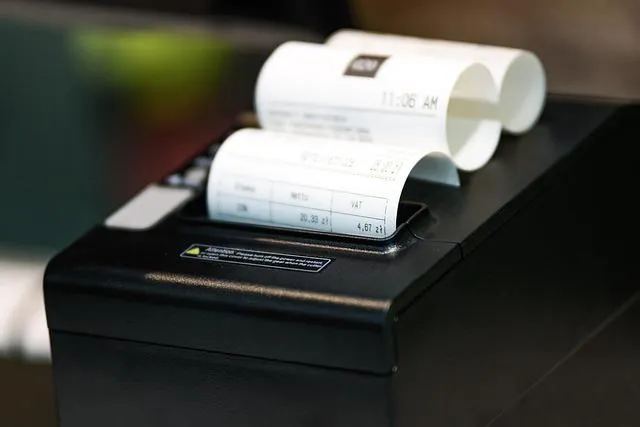
VAT (IVA), as its acronym indicates, is Value Added Tax. It is therefore a tax levied on final consumption, which means that only the final consumer pays it, not the self-employed worker or the business. For this very reason, when we buy or sell something, VAT is paid or collected, but we then settle it quarterly: it is paid over to the tax authorities.
.
Input VAT (IVA soportado) and output VAT (IVA repercutido)
Input VAT is the VAT that we “pay.” For example, when I buy a computer, I have had to “bear” VAT payable on the purchase of my PC, but it is a purchase I need in order to carry on my activity, so I can deduct it. In other words, input VAT is the VAT on expenses.
Output VAT is the VAT on the service provided. When we issue an invoice, we charge VAT for the service we have provided; that is, we pay the tax on that service, which will be borne by the final consumer. In our case, when we issue the invoice, this VAT is paid by the business or self-employed worker who engages us, and then, once we collect it together with the total invoice amount, we pay it over to the tax authorities. You need to be clear that this VAT is not ours. It is the VAT on income, which is why we pay it back.
Finally, we will subtract input VAT from output VAT in the quarterly and annual settlement.
Which VAT rate should I apply on my invoices?
There are currently three VAT rates: standard, reduced, and super-reduced:
Standard VAT rate
This is the 21% VAT rate. The usual one we all know. It basically applies to most of the goods and services we provide or that are provided to us. Unless a transaction falls under one of the next two rates, you must apply this one.
Reduced VAT rate
A rate of 10%. Examples include passenger transport, hospitality, the supply of food and beverages, and services for agricultural, forestry, or livestock operations, etc. You will find the full list in the table
Super-reduced VAT rate
Finally, the super-reduced VAT rate of 4% applies to basic goods such as foodstuffs like bread or milk, essential medicines, officially protected housing (viviendas de protección oficial), vehicles for disabled persons, etc.
IGIC = the Canary Islands’ VAT
IGIC is the tax equivalent to, or substitute for, VAT in the Canary Islands. It serves the same function as VAT in mainland Spain, but differs from it in several respects. Do you know the differences?
IGIC is the Canary Islands General Indirect Tax (Impuesto General Indirecto Canario). It is an indirect tax levied on supplies of goods and services made in the Canary Islands, as well as on imports into that territory.
Both IGIC and VAT serve to tax business activities, and they differ mainly in that the former is much lower than the tax applicable in mainland Spain.
This is because, given the Canary Islands’ status as an outermost region, it was considered necessary to have a much lower tax, under an entirely different tax regime, to offset the differences that living in an archipelago far from the continent, and everything that this entails, could involve.
In accordance with the legislation in force, below we set out the IGIC rates for 2022. As can be seen, there is a general rate of 7%; accordingly, any rate below this is a reduced rate, and all higher rates are increased rates.
• Zero rate: this applies to newspapers, magazines (provided they are not exclusively advertising publications), and books. It also applies to foodstuffs such as natural tubers, fruit, vegetables, and meat and fish that have not been industrially processed, as well as to works on officially protected housing, air transport, and medicines.
• Reduced rate of 3%: this applies to the mining, chemical, paper, and timber industries, not forgetting, of course, land transport and vehicle repairs, among others.
• Increased rate of 9.5%: applicable to certain supplies of vehicles for transport.
• Increased rate of 15%: cigars priced above €1.80 per unit, beverages derived from natural alcohols, shotguns and their cartridges, jewelry, watches, ornamental articles of glass, crystal, earthenware, ceramics, and porcelain, wool and fur rugs, fur garments or accessories, perfumes, and X-rated films.
• Increased rate of 20%: supplies of tobacco products.
The cases not listed here are therefore covered by the general rate of 7%, which, moreover, since 2020 has also included telecommunications in this category (mobile, landline, internet, and cable television).
Keep reading

The Spanish Tax Agency reverses a change in position applied de facto: U.S. entities may recover input VAT incurred in Spain by submitting an IRS certificate and a Resale Certificate
Supplementary report of the National Tax Management Office (Oficina Nacional de Gestión Tributaria) of April 28, 2026 (available here). Starting in mid-2025, businesses and professionals…

Holding company management services to subsidiaries are not a single supply for VAT purposes: implications of the Högkullen judgment for Spanish groups
Judgment of the Court of Justice of the European Union (CJEU) of July 3, 2025 (Case C-808/23, Högkullen AB) The relationship between holding companies and…

The EU General Court reinforces the right to deduct input VAT even where the invoice is received outside the accrual period
Judgment of the General Court of the European Union of February 11, 2026 (Case T-689/24) The recent judgment of the General Court of the European…
Explore the blog
Categories
Recent posts

Royal Decree-Laws 28/2026 and 29/2026 and the new regime for residential leases (II): tax measures
Royal Decree-Laws 28/2026 and 29/2026 and the new residential lease regime (I): lease term, evictions, and transfers

Shareholder exit through a capital reduction: two routes to channel liquidity and their taxation

Spanish tax authorities reassess retirement pensions and pension plan withdrawals of Spaniards under Portugal’s Non-Habitual Resident regime

Setting up a holding company mid-year: how is the main remuneration requirement for the Wealth Tax exemption calculated?
